Do it the Goalscape Way
Watch our short tutorials and read about the Goalscape method below.
Define. Prioritize. Track. Repeat.
Three simple steps — run the loop until the goal is done.
Define Goals and Subgoals
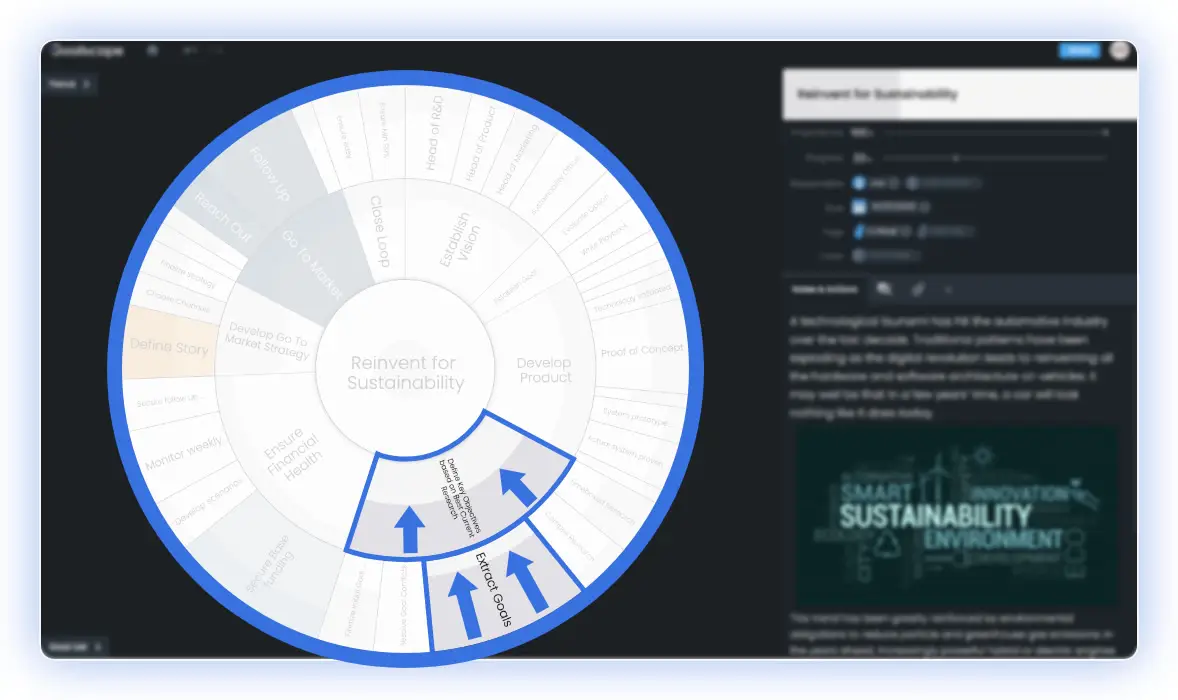
See the Big Picture. Visualize your goal structure clearly with Goalscape's holistic radial map.
Many users say: "Goalscape just makes sense. It works the way the mind works."

Prioritize and Act
Do what matters most. The relative importance of each goal is represented directly by its size. Adjust priorities visually and make smart trade-offs between goals.

Track Progress and Review
See at a glance what needs to be done. Progress fills in towards the main goal as darker shading. Spot what needs work instantly — it's any large goal that isn't filling in.
Update, Adapt and Repeat
Always keep your eyes on the prize. Goalscape encourages constructive dialog and a natural evolution of any goal structure — so your goals stay alive and keep moving as the world around them changes.

Why Goal Management Matters
Right now we all face unprecedented challenges, including:
- Global crises like climate change, geopolitical instability, and social inequality
- Disruption due to AI and remote work, forcing systemic changes in business operations
- A workforce engagement crisis costing businesses $8.8 trillion a year in lost productivity.
Challenges like these — large and small — are only resolved when we:
- Agree on the goals we need to set to resolve them, and
- Manage those goals effectively.
Supporting these activities is the essence of the Goalscape Way.
The Goalscape Way
Clear, well-defined goals improve motivation and engagement — and drive increased productivity. The Goalscape goal management platform provides a unique visual way for people and organizations to set, prioritize, and track their goals.
While Goalscape suits any management style, its major benefit is that it supports business owners, managers, and team leaders in igniting a collaborative growth mindset. Goalscape provides an easy-to-understand format to discuss and evolve goals in an agile way.
It's like tending a garden, where information flows freely both inside-out and outside-in. Goalscape transforms the traditional "top-down" organizational pyramid naturally — without requiring radical structural change.

This makes Goalscape the ideal platform for democratic, open, two-way information flow — so managers can grow teams that work effectively, inside-out and outside-in.
Goalscape calls for a strong beating heart of genuinely shared goals at the center, surrounded by the initiatives and actions required to achieve those goals.
As the world evolves, so must the landscape of goals and subgoals. Goalscape makes it easy to accommodate this change — the best way to motivate teams and inspire organizations, making them sustainable and successful.
This new way of working emerges naturally, step by step. It is not a top-down reorganization initiative that may never be fully accepted. As Buckminster Fuller famously said:
"If you want to teach people a new way of thinking, don't bother trying to teach them. Instead, give them a tool, the use of which will lead to new ways of thinking."
Goalscape does just that. It supports a holistic, people-centric approach to goal management, magnifying the engagement and motivation that are essential to productivity.
Goalscape Vision, Mission and Principles
Our vision: a world where people and organizations thrive by working toward clear, shared goals — together.
Our mission: to give everyone a visual, holistic way to set, prioritize, and track the goals that matter — so shared purpose becomes visible, and collaboration becomes natural.
To maximize the positive impact of Goalscape, we evolved these core principles from the Agile Manifesto:
- Purpose-Driven Work over Task-Focused Assignments
- Collaborative Goals over Isolated Objectives
- Empowerment and Shared Ownership over Control and Micromanagement
- Transparent Communication over Information Silos
- Adapt, Learn, Grow over Rigid Plans and Fixed Mindsets
- People and Planet over Burnout and Exploitation
These principles make Goalscape especially powerful in a team environment. Watch the video below to start putting them into action.
Follow the Goalscape Way with our Best Practice Guides
In this first video, we go through six simple steps and four practices for managing your projects and achieving your goals. Whether you're a team leader, student, professional, entrepreneur, or anyone looking to level up — you'll discover actionable steps to stay organized, boost productivity, and turn your ambitions into reality.
This video is about how to manage your projects and achieve your goals in 2026 with Goalscape. Let's get started. We've got six steps that we're gonna go through to manage your projects, and four, add-on practices that we recommend that you can build into your routine, but that are optional. Let's go through the six steps. First, first step, or before we get to the first step, um, let's just have a brief look at the traditional formats you can use to manage projects.
That is lists, mind maps, GaN charts and Kanban boards. Those formats have their place, no doubt about it. They have a long history. They had their evolution and they do great job, and you can do a great job with them, but they can be a bit unfocused and unbounded. Goals can get lost in these traditional formats. That's why we have invented Goalscape. Goalscape was in invented in a Olympic context. It's now used in many industries and many contexts all over the world.
And what sets Goalscape apart is that it's very focused and very bounded and very focused on the goals. The main goal sits in the center, and the circle represents the resource boundaries that we always, um, confronted with when we manage projects and when we aim for our goals. So in this way, Goalscape respects the power of clear goals by putting them in the center and the value of the time and energy we need to invest in achieving them, maximizing motivation, optimizing resources and it, and ideally in the end, achieving more.
How does it work With Goalscape? You see all your goals at a glance main goal in the center sub goal goes around it. The shading represents progress and the size represents relative importance. You can always double click on a goal to center it and double click on the central goal to focus back out. So let's talk about goals. Step one, we need to set a clear goal. That's always the starting point. Where do goals come from? Lots of places. Of course, they could be new business initiatives, they could be personal goals, they could be the result of the workshop.
And this is an example we have here. This is a media organization that had a workshop. And the resulting goal from that workshop was that they wanted to create an unbiased news platform that was the outcome. They collected a lot of information and thanks to ai, we can now take information like this that is somewhat unstructured and boil it into a first work breakdown structure or goal breakdown structure. And that's what we do in step and and that's what we do in step two, we slice down the goals into more manageable sub goals.
You can see the same gold structure that we had in this whiteboard now translated into a gold structure. The main goal sits in the center. The big sub goals go around it, the core platform development goals, the user engagement features, the analytics and the measurement that needs to be done for the platform and the product launch and growth. So this is the basic goal breakdown structure. It breaks down further. As said, we can always focus in on a goal by double clicking on it, and by double clicking on the central goal, we can focus back out.
So thanks to ai, we can now easily translate these. Um, we can now easily translate these workshop results into an initial goal breakdown structure. Step two, step two in the process. Step three, we need to define a timeframe. The timeframe can be loose or it can be tight, but without a timeframe, we cannot assign any sort of resource. The timeframe is the basic unit, the basic determine and Time is the basic resource. So if we don't attach some sort of timeframe to the goal we want to achieve, we're just going to be swerving around and we're gonna have a hard time dealing with any other resource.
It doesn't have to be exact. KAKE was invented in the context of the Olympic Games. You can't move the Olympic games there. You have a very definite timeframe in the context of agile software development, for example. You can have looser timeframes, but you always wanna relate your goal to some sort of target timeframe. And we'll talk a bit more about timeframes later on in Goalscape. You can just, uh, use the the GaN chart for the timeframe. In this case, I, uh, roughly plan for a year for this project.
And note that you can add timeframes for the sub-goals easily just by clicking inside the Gantt chart and well creating timeframes for the sub goal as well. You don't have to do this sort of waterfall planning. Of course you can go more agile. We'll talk about that, uh, in the practice that is about now and next. But, uh, note that you should have a basic idea about the timeframe. You, in fact, you don't even have to use the GaN chart for that, but you should at least in the central goal, define what the timeframe is like.
We'll talk a little bit more about the cadence further down this best practice guide. Step four is, well, you need people to achieve your goal. Maybe you're going solo long, uh, very likely you're going in a team and you need to assign people to your goals. If there's nobody assigned to a goal, the goal is not going to be achieved. It's very trivial. There's a filter in Goalscape. If you click top left here on the focus panel, you can, uh, click on edit.
And then you find under more filters, you find the has responsible filter. Let's select that. And now all the goals are highlighted that have a responsible. And we can see there's a couple of goals which are dark that don't have a responsible person assigned yet. We can simply do that by, uh, selecting the goal and choosing a person. Let's say Chris is doing this one and he's also doing this one. The bottom line is if your goals don't have people assigned to them, they're not going to get achieved.
It's like a basic requirement, obviously, to achieve a goal. The next step prioritize well is very likely that you have to prioritize along the way. Why? Because we run out of time and we run out of resources. And then we need to decide which other important goals we should achieve first, which have more, we call that bank for the buck, or if in doubt, which goals carry more weight and contribute more to the higher goals relative to their cost. Bang for the buck.
That's what we call it. So you set relative importance in Goalscape. You make one goal more important, you can see the other goals become less important. This is a very easy way to create an overall map of your goals. And their relative importances could well be that all goals are equal. It's easy to do, you just right click and you, uh, equalize the sub goals. But very likely, often that's not the case. Goals carry a different kind of weight goals carry different weights, and there's no better way to visualize that than Goalscape.
Let's move on. Step number six. Well, you're ready to make progress to review your goals and to adapt them along the way. And let's look at what that looks like in the real world. How a Goalscape project evolves. Here. We have created a project and a work breakdown structure with our inbuilt ai. But now we're working on the goal. We are adding goals. We're subtracting goals, we're creating new goals. We're adjusting importances, we're marking progress, we're adding color.
Um, and you can see how we grow towards the goal. The shading grows towards the central goal. In the central goal. The shading grows from the inside out, and that's how we visualize progress. We're using color for certain things. And what you have here is essentially a growth model. So these are the six steps. Easy to do, easy to memorize, just six steps to manage your projects. Now let's look at the additional practices that we recommend. You don't have to follow these, but they are useful ideas and useful practices and disciplines you may want to follow.
First, it helps to define a check-in cadence. What frequency do you use to meet to update your goals, to check your progress, um, to come up with new plans, to exchange ideas with your teammates? Could be quarterly, could be monthly, could be biweekly. It could be weekly, maybe two or three times per week or even daily. That these are the options. Obviously you will fall somewhere in here. The important bit here is there's probably not one cadence or frequency that works for all the goals in the same way.
And this is what annoys people. If, if, um, a one size fits all cadence is forced onto the whole team. OKR worked with quarterly goals for where very long time. And I believe it has failed because some projects run longer than, much longer than a quarter, and other projects are much shorter. You can't just have the same cadence for all. In general, we do believe that a very frequent check-in is super helpful. We'll, uh, come to that in a second. It's about talking about the goals more frequently, which keeps the motivation up and which keeps people on the ball.
Uh, but forcing reporting frequencies onto people in a way that doesn't match the goal is not a good idea. So it's important to pick the cadence, uh, but maybe not for all the goals in the same way, maybe different goal branches. Sub goal branches need a different cadence. It really depends, um, on the goal. So adapt as required. That's the simple practice. Uh, A and we have B, C, and D coming up. So what is practice B? Let's go to the next slide.
Um, well that still belongs to the check-in cadence, and that's a recommendation from the MI two m mi. That's from, and that's a recommendation from MIT's Sloan School of Management. They've, uh, research has shown that teams that frequently discuss their goals, that make the goals ambitious, specific and transparent, kind of like smart, but a bit more condensed emit, bit more punchy. We like that model better than the smart model teams that frequently discuss their goal, keeps keep their goals alive in every conversation and not locked in and, and not locked in annual reviews.
Frequently discussing goals can be a very powerful way to push projects forward. That doesn't mean you should have unnecessary meetings, and we'll talk about what, uh, makes, uh, a meeting super effective, but to have a more frequently can be the right measure to, uh, increase the likelihood of project success. Another practice that we, uh, recommend and that, that we enjoy ourselves is to define what's now and what's next. Which goals are we working on now, and which goals do we tackle next?
And we simply do that by tagging. We tag the goals with a now tag and a next tag. And once we've done that, we can simply select them in this filter. By the way, you, you can select the focus filter top left here and you can pin it. And then if I select the now tag, I see all the goals. I don't need the GaN chart right now. I see all the goals that, uh, are being, being worked on right now, and I can also select the people who are working on them.
So Peter has these two goals. And by the way, our recommendation is to have not more than three goals on the now list because, uh, if you put more on your now list than that, you dilute your focus. So Peter is working on those. Mark is working on those two. Ethan is working on those two. Once they're, um, now list gets depleted, they can pick from the next list, either their personal next list. Let's say Ethan only has three next goals or the team's next list, uh, which is a more condensed list, a more focused list than, uh, what you have, uh, than the overall list.
This is all the goals. And if I select next, I boil it down to the goals that we have selected as next in a goal review. So now, and next, a super simple way of dealing with them. If you want to pick a next goal, you can select it and then you switch the next tag to a now tag. And, uh, then it will show up on your now list. So if Chris is now selecting this goal, he has that additional goal on his now list. We'll make that more, uh, intuitive and more simple, uh, probably in 2026 where this will become a toggle, but for now you have to switch the tack.
Now. Next we think a super powerful method to get stuff done and to focus. Now let's talk about add-on practice C, and that is tight confidence. We think that is a super powerful way of making meetings very, very efficient. Depending on what your goal review cadence is, ask people, ask yourself, what is your confidence of achieving the goals within the timeframe that you've set for yourself? Is it high, medium, or low? You could get more advanced than that and have a scale from zero to 10.
But let's assume we only have these three categories, high, medium, or low. Then you can mark them as green confidence, high yellow confidence, medium or red, confidence low. If goals shift into confidence low, it's probably time to talk about them, because it either means somebody needs help or a goal should be discarded. If the confidence stays low for too long, then um, uh, it's a, it's a reason to escalate and to gather the team and to try to find out what could be done to achieve the goal.
And these can be great learning exercises, uh, and you can establish a very simple helping culture that way. And what else? You don't get these meetings where you talk about all the great things people have done and how people defend what they're doing, and maybe even the overconfident people. Um, uh, talk about how great everything is. You really want to talk about the things that are in danger of not being achieved. Uh, you don't want to have a gloomy meeting, but you don't want to carry around baggage that cannot be, uh, come to fruition in the long run.
So you want to know which are the goals where people, uh, have low confidence and can it be changed in any way. So highlighting confidence can be a super powerful tool to drive a project forward actually, and to, um, also make meetings very efficient. The next practice a bit more complicated. Um, and that is, well, it's actually practice DI think that's the last one we're gonna talk about. It's about value editing goals. It's about framing goals in a way that increase motivation and engagement.
Before we look at how that can be done, let's talk briefly about motivation and engagement. We follow a simple model where we, uh, gauge engagement from actively disengaged to inspired. And we believe the reality is that most business is happening on the disengaged and the engaged level where engaged kind of starts with people being compliant with what they're contractually supposed to do. But that's not very high engagement. Yet active engagement, uh, is already a, uh, entirely different breed.
That's what you get in, uh, successful sports teams and in teams that really win. You have occasional moments of inspiration, stretches of inspiration, stretches of flow. That's the very highest form of engagement. Now, what drives engagement? We, we think there's really two main drivers and one additional driver that is kind of a subset of the second one. Um, the main driver is clarity about goals and the experience of progress. This so easy to have in sports, it's more difficult in business because the goals are more cloudy.
Again, a reason to talk about goals more frequently. The second driver is personal relevance. If that is absent, if the goal doesn't matter to the person who's supposed to achieve it, then they're not going to invest a lot of energy. And that has something to do with the pains. It relieves the achieving the goal that has something to do with the, the pains that achieving the goal relieves or the gains that are being created by achieving the goals.
And it has a lot to do with values which are more broad goals. And that's where we get to in a minute what value editing goals really means. And the third one is higher purpose. It's been discussed a lot in the past, really 20 years as one of the key drivers. I believe it's important. We believe it's an important one. If you can create collective meaning a higher purpose, that's can be very powerful. But not if the first two are not in place. People need to have clarity about the goals.
They need to have personal relevance and the values that they deem important need to be respected. If, if you, if their values are violated, the higher purpose doesn't do anything to them. So how do these engagement levels map onto the drivers? Well, if you, uh, set clear goals, you get people engaged. If you create personal relevance, you get them actively engaged. And if you have a higher purpose, you may get them inspired. It's a very simple model, but this encapsulates a lot what's actually happening on the ground.
And people who are disengaged simply do not have goals. They don't feel relevant, and they have no purpose and actively disengage people. They sabotage their teams and their company. They actually have negative goals, and they have a cynical, uh, mind view, uh, a cynical negative relev relevance and a negative purpose in their life. Um, these are relatively rare luckily, but they do happen. And then they don't have a place in a, in a productive team.
Um, but the disengaged people, um, and even the actively disengaged people can be lifted up through clear goals and personal relevance and maybe even a higher purpose. Now, values are very well researched, and if you want to edit your goals so they speak to the values of your people, um, you may want to look at this, uh, research of SH Schwartz. He came up with a very, uh, sound and reproducible model. And I, we don't have the time to get into it in depth, but it basically explains why people have liberal leanings or conservative leanings and why people, some people are more self-focused and others are more socially focused, and all people are different.
It's important to note there is not these typical types that, uh, everybody is unique, but we can create some types to get an understanding what it means to deal with these differences. And, um, before we do that, um, I, I wanted to share this graph where, uh, imagine the square is the sum of all organizations on the planet, and the red ones are disengaged, which is actually what Gallup, the Gallup organization finds on a regular basis. It's almost like two, uh, three fourth, um, 75% of the global workforce is disengaged.
It's, it's in the red. And, um, you get engaged people if you create goal clarity, but then they can easily hit a wall if on the value axis, which in my opinion in the moment is the dominant axis, uh, if people feel that their basic values are not aligned, then they hit a glass wall and you won't get 'em into the actively engaged area, even if you try to create personal relevance. And, um, the next level purpose achieved that goes hand in hand with strong value alignment, where the values of the organizations align with the values of the people who work there.
Now, if you look at, uh, these different quadrants or these different areas, you get all sorts of expressions. But let's imagine we have four types of people here. We have a visionary idealist, we have an ambitious pioneer, we have a disciplined achiever, and we have a caring guardian, full types of people. And we have three types of goals here. One is to create an unbiased news platform. The goal from our example in the beginning. The next one is increasing the annual revenue by 15%.
And the last one is to launch a new product in, uh, Q3. Now, let's just look at some examples here. The visionary idealist on the, on the unbiased news platform. Uh, maybe a goal that's, that is formulated like this would speak to him. Um, build an unbiased news platform that elevates truth, transparency, and informed citizenship, proving that ethical information empowers society. Now, the caring guardian for them, or let's look at the ambitious pioneer.
The ambitious pioneer may like a goal that sounds like this launch, a breakthrough, unbiased news platform that challenges industry norms and redefines how people access clear unfiltered information. Two different one on the same goal, but two different expressions, two different ways to address their values or this goal. Increase annual revenue by 15%. For the visionary idealist, you may say, grow revenue by 15% by helping more people achieve meaningful results, proving that purpose-driven success scales.
Whereas the ambitious pioneer would maybe like this goal better win 15% more revenue by outperforming competitors and breaking into new markets with bold moves. So this is what value editing is about. You have one and the same goal, but you wrap it up in different ways, but not in manipulative ways. You wrap it up in ways that speak to the people and that speak to the core values of the people that you work with. Uh, it's the same goal. It's a different reason to care.
And how do you find out what motivates people by talking to them one-on-one? That brings us back to the, to the F in fast frequently discussed goals. The best way to find out what moves your people is to talk to them. And, um, that's why our recommendation is to, uh, spend more time talking about goals and working on the goals and finding out what makes people click. Because only if they want to achieve the goal will they really make a difference in achieving it.
So that's what value editing is about. In the future, we may want to help, uh, managers formulate these goals. Uh, it can be very, it can be done very in very systematic ways. You can actually take a PVQ test and understand better who has way to value fingerprint. Um, but we think the, the best and easiest way initially is to talk to people, but don't assume that the goals that motivate you also motivate other people. That's important to note because we have these different value fingerprints and in the end, values are goals themselves.
They're just very broad goals. There's, there are lines that we don't like to step over. And, um, hence if those values are violated in, in a, in an environment, maybe because a company is solely about profit, where a lot of people working in the company are about partnership, they're about, um, caring for others. They're about security, they're about preserving stuff. Um, and other parts of the company may be highly innovative. They want to break things and, and, and, and innovate.
Management means bringing these different values together and, and, and using the strength of individuals in order to achieve a common goal. But that requires communication. Now, um, That's value editing goals. And that concludes our six steps and our four four add-on practices. Let's go through them one by one quickly. Uh, first we set a clear goal, then we slice it down into more manageable sub sub-goals. Then we define a timeframe or timeframes.
We can do that loose or tight. Then we identify goal owners and assign them as responsible. Then we prioritize, uh, depending, you know, can be different levels of priority. It could be all equal. Or maybe sometimes we have highly, uh, a highly prioritized structure. And then we make progress, review and adapt the goal structure on the path to achieving the goal. Four practices that can help us on the way we should define, um, uh, fitting check-in cadence.
Note, not necessarily the same cadence for all goals. We can define now goals and next goals to help us with agile management and to, uh, sift through the overall goal structure. And we can highlight confidence maybe through color, maybe through tags to understand which goals have a high confidence and which goals had a drop in confidence. And then we can escalate that and find ways of addressing it. Confidence is a very accurate or the best estimate we can get from our intuitions and our gut about where we are going better than a lot of measurement.
And the last one was value editing goals, framing the goals to increase motivation and engagement. Highly interesting topic for 2026. Uh, the science is a bit gloomy about, uh, workplace engagement and we need to do something about it. And these are our ideas and recommendations for 2026. Good luck and have a wonderful end of the year and a good start into the new year. And, uh, Goalscape is here to help you achieve your goals.
Managing Annual Goals with Goalscape
This Best Practice guide shows how to manage and iterate annual goals with Goalscape — use it as inspiration to find your own best way of managing your goals in an agile way.

This is our best practice guide on how to manage your annual goals with Goalscape. You can look at this as an annual iteration cycle or a smaller or larger timeframe. We like the year as a timeframe because it's so natural. It's got a beginning and a nice end. Uh, it's got some breaks in between. It's got celebration times. We think the year is a good framework, but of course you can start any time during the year and you could also use it for longer or shorter timeframes.
But what's most important when you set annual goals or longer term goals is that you have a powerful north star in the center. And you wanna make that simple and you wanna make that powerful. And we'll look at some examples in a minute. Once you've got your North star, you define the sub goals that are aligned with that north star, and you wanna make those concrete. You want to avoid abstraction wherever possible because abstract things are not very motivating.
And we'll look at that in a little bit more detail in a minute. Then you want to clarify the ownership of the sub goals. And then you are ready to do a big picture review of all the goals you want to achieve in that timeframe. And you want to tag one to three goals as goals that you do now. And you simply do that by adding a now tag and then maybe five to 25 goals as next. And that will comprise your next list. Once you've done that, you start focusing and you achieve your now goals that you have to defined.
Once you've done that, you celebrate, never forget to celebrate life short, cherish your achievements, your learnings, and even your setbacks. They are part of any creative process. And then review your next list and tag one to three goals is now, and you repeat that cycle maybe 1, 2, 3, 4 times until you want to do another big picture review. And in that review, you evolve your goals, you evolve your priorities, you celebrate your progress. And most importantly, fill up your next backlog.
Bring your list of next items up to 10 25, roughly in that ballpark. And you wanna do a couple of those reviews throughout the year. You can do them quarterly, you don't have to. And maybe some parts of the organization do it quarterly and others don't. We don't subscribe to the whole organization having to do quarterly goals. They just don't fit different project scopes and timelines. So it's important to do the big picture reviews, but do it more organically.
And then at the year end, it makes sense to celebrate the overall progress throughout the year. Reflect on the north star, reflect on the goals, achieved, evaluate. But above all, celebrate again. Life is short. You want to cherish your achievements, your learnings, and even your setbacks. So the complete iteration cycle looks roughly like this, and this simple process will ratchet you up towards success. And it will do it in a very organic, and as we like to call it truly agile way.
Because you're adjusting not only your project scopes in an agile way, but you're also adjusting your goals in an agile way. That's the Goalscape best practice guide. And how does that look in reality? Well, let's look at two examples. Here is the schematic structure of a company. Goalscape. You could order it by departments, but we don't think that is such a good idea because what really motivates people are real tangible things. And what do companies output?
Well, they output products and they output services. So you want to use those as your main motivators. It's easier to mo motivate people around those things because their touchable, tangible services are about relationships. Products are about real world objects, and it doesn't have to be the glorious iPad. It could be a valve that a company produces that saves energy. That's something to get excited about and it's an important contribution to society.
And events and places are also good goals to gear towards. But there's elements that are more abstract, like the financial health, super important, but slightly more abstract. You'll be left with those abstract goals, which is fine. They just require a little bit more love and a little bit more attention to keep people motivated and also to generate appreciation in these other areas, in the product areas and the service areas for those people here who are keeping the company financially fit.
So creating a goal structure that is, uh, as much as possible about these concrete things. And then investing energy and dealing with the more abstract goals in a engaging way, that's our recommendation. And what does that look like? On a personal level, you can break down personal goals into some sub areas. Typically it's between five, six or up to nine 10 maximum. Things like health, the living environment, career and job relationships, personal growth, money.
You can set sub goals in those areas. And then when you break 'em up, what you want to do is do this big picture review that we looked at in the beginning. And you start tagging goals as now. And next, let's look at the complete goal list. Okay, so this is the complete list of goals, but if we only select next, it's a much shorter list. It's 10 to 25 items, somewhere in that ballpark. But which of these goals do I tackle next? Well, I do a review of those and then I tag 'em as now and I end up with three items on the list and I work on those.
And then I pick new items from the next list. So how do I change a tag on a goal? I simply delete the next tag and I add a now tag. We'll eventually make this a toggle to make it even easier, but this allows you to manage your now and your next list. Note that you can display your list. That's flat lists. You don't have to look at the whole tree all the time. And this also works in a company context. Of course, you've got many more goals and you may have a team of people working on all your goals.
So if we look at the complete list of goals, it looks like this, but now we select the items that people work on. Now that's the current goals that people work on. But let's look at what a given person works on. I just pick the person here and the now tag. And it gives me the list of goals that Karen, for example, works on currently. If Karen is done with running the customer survey, she deletes the now tag, goes back to the focus panel, checks out her next list and picks another item.
Let's say simplify the user interface is the goal that she wants to work on. And she simply changes the tag from next to now, and now it will appear on her now list. Let's pick the now list again. Okay, simplify. The user interface is now on her now list. We think it's good practice to not keep too many things on the now list. One to three is fine. Occasionally it could be more, but it makes it harder to focus. So let's look at an example of a good North Star.
Let's look at the one from Tesla. Tesla's North Star is to accelerate the world's transition to sustainable energy. It's simple and it's powerful. It's somewhat emotional. It's about making the planet better, saving the climate. So that's a good North Star. Look at the one from Airbnb to help create a world where you can belong anywhere and where people can live in a place instead of just traveling to it. Really nice. It's concrete, it's emotional, it's simple.
Very powerful. North south, what's ours? Our goalscapes and North Star is to help humanity achieve great goals. That's what we build Goalscape for. We want people to set goals against the realization that we have finite resources. The resources of this planet are limited. The time in our life is limited. We want to pick the right goals and we want to prioritize them well, and we want to make progress towards them without stressing out. So we wish you good luck with all of your goals.
You can start using Goalscape at any time throughout the year. But if you want to stay motivated, break down your goals, iterate in small steps, focus on what matters now, decide what's up next and review the big picture frequently.