See the Big Picture: Goalscape Best Practices
Many people have asked us for best practice advice to make the most of Goalscape. So we came up with a simple iterative process that will help you to …
This is our best practice guide on how to manage your annual goals with Goalscape. You can look at this as an annual iteration cycle or a smaller or larger timeframe. We like the year as a timeframe because it's so natural. It's got a beginning and a nice end. Uh, it's got some breaks in between. It's got celebration times. We think the year is a good framework, but of course you can start any time during the year and you could also use it for longer or shorter timeframes.
But what's most important when you set annual goals or longer term goals is that you have a powerful north star in the center. And you wanna make that simple and you wanna make that powerful. And we'll look at some examples in a minute. Once you've got your North star, you define the sub goals that are aligned with that north star, and you wanna make those concrete. You want to avoid abstraction wherever possible because abstract things are not very motivating.
And we'll look at that in a little bit more detail in a minute. Then you want to clarify the ownership of the sub goals. And then you are ready to do a big picture review of all the goals you want to achieve in that timeframe. And you want to tag one to three goals as goals that you do now. And you simply do that by adding a now tag and then maybe five to 25 goals as next. And that will comprise your next list. Once you've done that, you start focusing and you achieve your now goals that you have to defined.
Once you've done that, you celebrate, never forget to celebrate life short, cherish your achievements, your learnings, and even your setbacks. They are part of any creative process. And then review your next list and tag one to three goals is now, and you repeat that cycle maybe 1, 2, 3, 4 times until you want to do another big picture review. And in that review, you evolve your goals, you evolve your priorities, you celebrate your progress. And most importantly, fill up your next backlog.
Bring your list of next items up to 10 25, roughly in that ballpark. And you wanna do a couple of those reviews throughout the year. You can do them quarterly, you don't have to. And maybe some parts of the organization do it quarterly and others don't. We don't subscribe to the whole organization having to do quarterly goals. They just don't fit different project scopes and timelines. So it's important to do the big picture reviews, but do it more organically.
And then at the year end, it makes sense to celebrate the overall progress throughout the year. Reflect on the north star, reflect on the goals, achieved, evaluate. But above all, celebrate again. Life is short. You want to cherish your achievements, your learnings, and even your setbacks. So the complete iteration cycle looks roughly like this, and this simple process will ratchet you up towards success. And it will do it in a very organic, and as we like to call it truly agile way.
Because you're adjusting not only your project scopes in an agile way, but you're also adjusting your goals in an agile way. That's the Goalscape best practice guide. And how does that look in reality? Well, let's look at two examples. Here is the schematic structure of a company. Goalscape. You could order it by departments, but we don't think that is such a good idea because what really motivates people are real tangible things. And what do companies output?
Well, they output products and they output services. So you want to use those as your main motivators. It's easier to mo motivate people around those things because their touchable, tangible services are about relationships. Products are about real world objects, and it doesn't have to be the glorious iPad. It could be a valve that a company produces that saves energy. That's something to get excited about and it's an important contribution to society.
And events and places are also good goals to gear towards. But there's elements that are more abstract, like the financial health, super important, but slightly more abstract. You'll be left with those abstract goals, which is fine. They just require a little bit more love and a little bit more attention to keep people motivated and also to generate appreciation in these other areas, in the product areas and the service areas for those people here who are keeping the company financially fit.
So creating a goal structure that is, uh, as much as possible about these concrete things. And then investing energy and dealing with the more abstract goals in a engaging way, that's our recommendation. And what does that look like? On a personal level, you can break down personal goals into some sub areas. Typically it's between five, six or up to nine 10 maximum. Things like health, the living environment, career and job relationships, personal growth, money.
You can set sub goals in those areas. And then when you break 'em up, what you want to do is do this big picture review that we looked at in the beginning. And you start tagging goals as now. And next, let's look at the complete goal list. Okay, so this is the complete list of goals, but if we only select next, it's a much shorter list. It's 10 to 25 items, somewhere in that ballpark. But which of these goals do I tackle next? Well, I do a review of those and then I tag 'em as now and I end up with three items on the list and I work on those.
And then I pick new items from the next list. So how do I change a tag on a goal? I simply delete the next tag and I add a now tag. We'll eventually make this a toggle to make it even easier, but this allows you to manage your now and your next list. Note that you can display your list. That's flat lists. You don't have to look at the whole tree all the time. And this also works in a company context. Of course, you've got many more goals and you may have a team of people working on all your goals.
So if we look at the complete list of goals, it looks like this, but now we select the items that people work on. Now that's the current goals that people work on. But let's look at what a given person works on. I just pick the person here and the now tag. And it gives me the list of goals that Karen, for example, works on currently. If Karen is done with running the customer survey, she deletes the now tag, goes back to the focus panel, checks out her next list and picks another item.
Let's say simplify the user interface is the goal that she wants to work on. And she simply changes the tag from next to now, and now it will appear on her now list. Let's pick the now list again. Okay, simplify. The user interface is now on her now list. We think it's good practice to not keep too many things on the now list. One to three is fine. Occasionally it could be more, but it makes it harder to focus. So let's look at an example of a good North Star.
Let's look at the one from Tesla. Tesla's North Star is to accelerate the world's transition to sustainable energy. It's simple and it's powerful. It's somewhat emotional. It's about making the planet better, saving the climate. So that's a good North Star. Look at the one from Airbnb to help create a world where you can belong anywhere and where people can live in a place instead of just traveling to it. Really nice. It's concrete, it's emotional, it's simple.
Very powerful. North south, what's ours? Our goalscapes and North Star is to help humanity achieve great goals. That's what we build Goalscape for. We want people to set goals against the realization that we have finite resources. The resources of this planet are limited. The time in our life is limited. We want to pick the right goals and we want to prioritize them well, and we want to make progress towards them without stressing out. So we wish you good luck with all of your goals.
You can start using Goalscape at any time throughout the year. But if you want to stay motivated, break down your goals, iterate in small steps, focus on what matters now, decide what's up next and review the big picture frequently.
Many people have asked us for best practice advice to make the most of Goalscape. So we came up with a simple iterative process that will help you to manage goal setting, work processes and progress tracking for truly agile productivity. See the big picture, then dive into the detail and focus to get things done. Watch this video to learn more. If you'd like to use either of the goalscapes shown in that video you can read the public versions here:
To use either of these as a template for your own goalscape, download it (click the Download button and select 'Goalscape Project'), Save the .gsp file on your hard drive, then login to Goalscape and Upload the .gsp file using the 'Import goalscape' button in the Home screen: 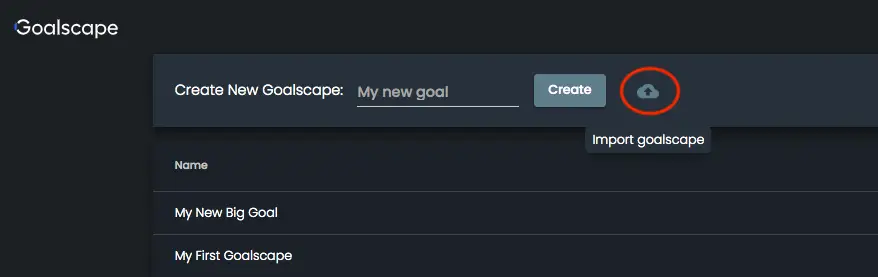 If you do not yet have a Goalscape account you can Register for a Free Trial.