The Brian Tracy Goals Method
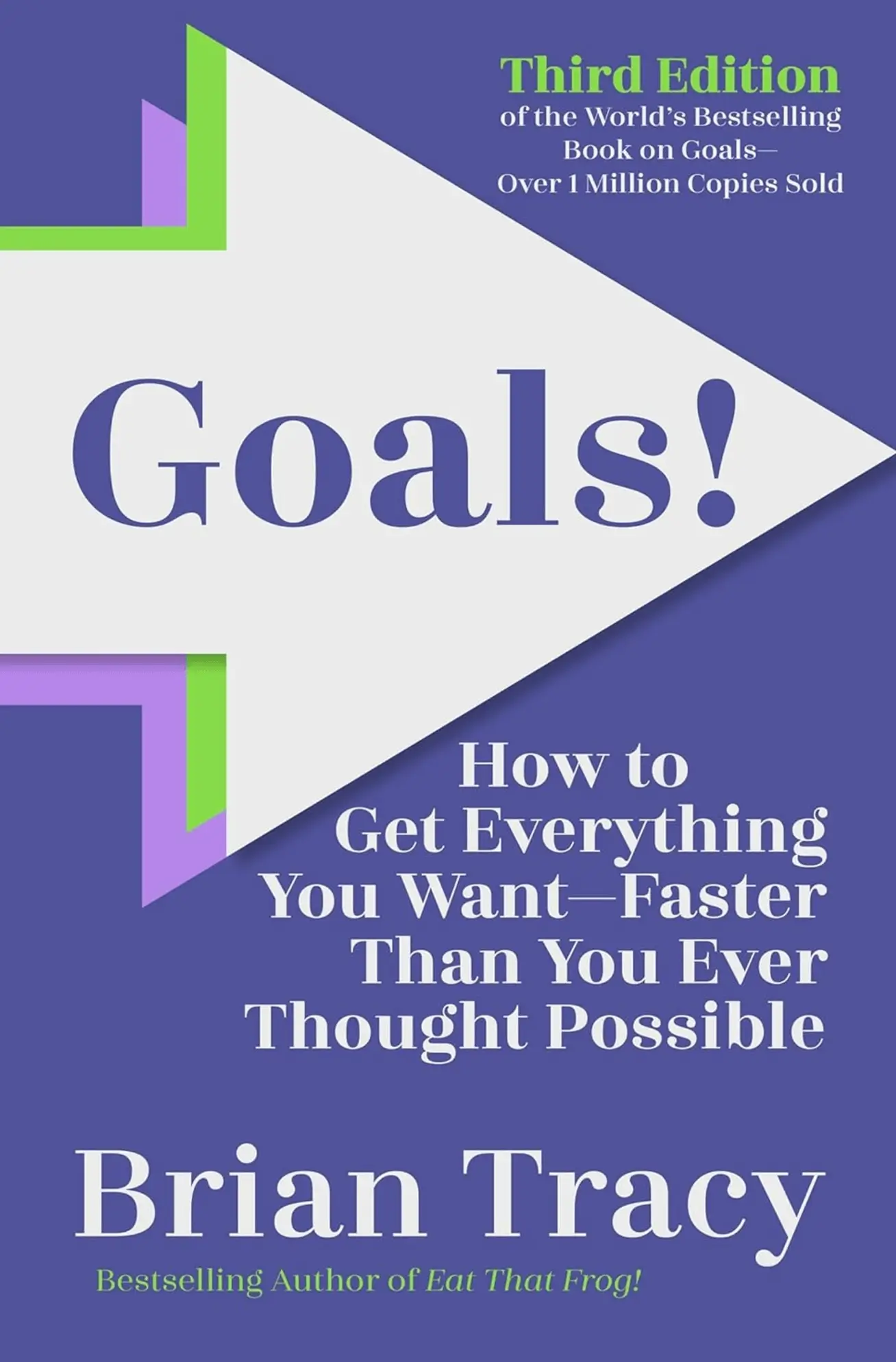
Brian Tracy's 'Goals!: How to Get Everything You Want Faster Than You Ever Thought Possible' is the bestselling book on setting and achieving goals. Goalscape's Marcus Baur joined Brian on Greg Voisen's 'Inside Personal Growth' podcast to discuss the power of goals. Watch it here:
You are in for a special treat today. Brian Tracy, in the lower left hand corner has done his third edition of his book Goals with over a million copies sold. It's how to get everything you want faster than you ever thought possible in the upper left hand corner of this screen is Marcus Barr. He's got a background as a former Olympic sailor. He understands the power of focus, perseverance, strategic planning, and he's channeled these experiences into the Goalscape software.
It's a visual goal management tool that empowers users to clarify their priorities, track their progress, and achieve their most ambitious objectives. When I was 21, I read Naval and Hill's book, think and Grow Rich and Think and Grow Rich makes a very clear point. The starting point of all success is desire and a clear, major, definite purpose or one big goal. And he spent, uh, 20 years interviewing 500 of the richest men and women in America to find out how they got from nothing to where they were.
And the number one factor was goal setting. They always say it was the goal. I had no idea how important goals were. And Marcus has had the same experience when they learn about the importance of goals and how this organizing principle is so powerful, you can achieve more in five to seven years, then you might be in 50 or 70 years. That's why we're excited about the subject. Marcus, how does the Goalscape software compliment the principles outlined in Brian's book and what unique value does it bring to goal setting and goal achievement?
When I was young, I had small goals as a teenager and then my goals got bigger. At some point I wanted to go to the Olympics and I needed a map to get there. And mind maps didn't quite do it because they blew out in all directions. And the problem with any goal we have, we only have 24 hours every day. So what do you make of it? And that means you have to prioritize really carefully. And Goalscape draws a super simple map where you put your big goal at the center and then you break it down and then you prioritize and you can break it down further and then you can prioritize on that level as well.
And then you can make progress. And that again reflects into the map. You mark your progress through shading that goes from the outside in towards the big central goal. And when you do that, you quickly see where your white spots are. Yeah, the goals you have, high priority but low development and that's where you want to focus on. So it's just the method to keep the overview and to keep clarity in your big challenges. My favorite law is uh, the law of cause and effect, which was first meed by Aristotle.
And one of the things he said is that there's a reason for everything. And if you want to achieve a particular goal, the starting point is for you to decide what goal it is that you want to achieve. Most people are unclear, they have vague goals, they have general goals. I have people come up to me and say, well, I decided I want to be a billionaire in one year. And I say, well, why don't you try to be a thousandaire in one year? So people are unclear and as a result it's like driving through the fog.
They're never clear about where they are. Clarity comes from writing it down and Marcus has found this out the same way. The most important thing is to start moving forward with clarity. Now Marcus, I have a question for you because visualization is a key aspect of what we've just talked about and it's about goals and Goalscape. And your software is all about visualization. Let's actually take an example and we use the classic example of the wheel of life.
So this would be a typical wheel of life. Let's assume someone has the goal of having a balanced life with many more moments of joy than of worry. Then you break it down into your health, your living environment, your career and your job, your relationship, personal growth, money, leisure and free time. And maybe to others, maybe you make it a little bit more simple. Let's say someone is in the situation where he says, well, all these things are gonna get better if I have more money, okay, it's gonna make everything else better.
So I focus on this in a large part, and that's fine that that could work out well. And what we see immediately, he's done his assessment, he looked at the current state of his health. It's not optimal. You see the shading 50% filled in his diet is good, but sleep is bad exercise. Not much of that. Well, maybe some more exercise will make the sleep better. So it's that kind of thinking, you know, you see the structure and you see the progress and you see the white space.
And you can also see what if you go outta whack? What if you only go for the money? Well, you won't have much of a family life, right? Is that a balanced life? Definitely not. So you wanna strike a balance. That's what it's about. Now let's look at a strategy example. And that's really what Brian's book is about. It's a strategy and practice and habits and wisdom on how to achieve goals. And we just extracted a couple of elements that we thought were the most important ones for an introduction.
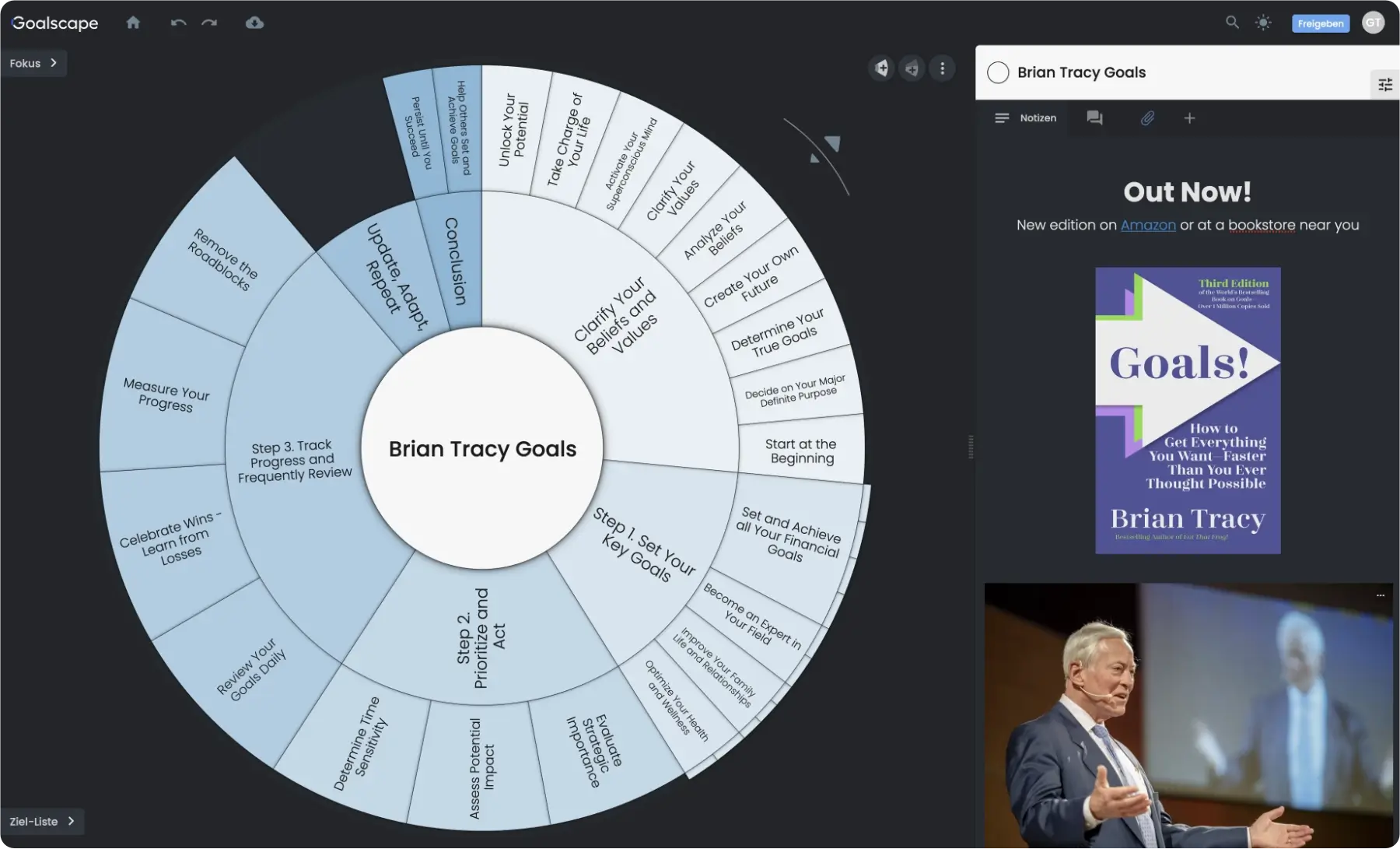
This is not a replacement to reading the book in no way. You have to read the book and I recommend to anybody to read the book and then go back to the beginning and read the summaries at the end of every chapter, which are awesome. And the things that we found most important, we put on the first level is that you need to clarify your beliefs and your values and that breaks down into a bunch of smaller goals that you wanna achieve. What are the values?
Analyze your beliefs. Setting a goal is the opposite of a limiting belief. It's the belief that something is possible that you can push the boundaries. And then how do you set your key goals? The next one here is step two, prioritize and act steps. Three, track progress and do frequent reviews. Then because you hit those closed doors, that's inevitable. Failure is inevitable. Life throws you curve balls all the time. You need to update, adapt, and repeat.
So that's just a simple template to get started. And we recommend to people to go through these and ensure that they understood the basics. To let the listeners know, Marcus, if you sign up for your 14 day free trial, you can get this template. How would both of you address the self-disciplined to actually not only write the goals, but then to continually work on the goals throughout the rest of the year? When You do something positive, when you set a goal and take one step toward it, you get a feeling of happiness and health.
You develop what is called a positive addiction and you want to do it again and again. That's why when people write down their goals and then make a list of things they can do to achieve it and then start on number one, they feel happy. And as Aristotle said, that desire for happiness is the primary driving force in human life. Everything that people do is to be happier than they were before. So what does successful people do is they addict themselves to positive behaviors.
And one of the most positive behaviors is the step by step motion toward the achievement of something that's important to you. And that's one of the reasons why Marcus and I and you are so excited about goals because when we work on our goals and we feel ourselves moving toward our goals, we feel happy. And that's really the ultimate aim of human life. How do you keep yourself disciplined to actually get to go do something like the Olympics? Research has shown that there is a thing called the middle slump.
People are really motivated when they set themselves a goal. Like that's the New Year's thing. I'm gonna improve my diet, I'm gonna go and exercise. They're really excited in the beginning. But if the end of the goal is far away, when will I have lost the 10 kilos? When do I look the way I want to look? That's a long way away. And then the motivation fades, and that's called the middle slump. And you can hack the middle slump by breaking down your goal.
And that's something you must do. And that by that you train your inner motivation and reward system. And some people have learned this more as young children than others, but you can train it at any time in your life. You just have to do it. You have to break down your goals. So in the example of fitness, you have to decide, I'm gonna go three times a week. And then when I go there, I'm gonna do these 10 exercises. And for each exercise I'm gonna do three sets and I'm gonna write down that I'm gonna do 10 repetitions and then next time I do 12.
So Marcus, to you, how do you think this software could help people set achieve goals, help themselves be better balanced? Sometimes You want to strike a balance and sometimes you don't want to strike a balance. And it's important. There's different phases in life. People want to find something that they excel at. You can't do that at everything. It could be a very small thing. It it, it's very different for different people, what makes them click.
But it's a gift in life. It if for some time you try really, really hard at something to become really, really good, you don't have to do that in all areas of life because at some point you gotta come back and strike a balance because a healthy life in the long run is a balanced life. If, if you're serious about achieving your goals, you must write them down. That's a law of nature. They don't fall from the sky. You need to work on them and you need to document them.
And you can start with pen and paper. But if you then want to go further and maybe also work with a team and manage your goals, you can go to Goalscape. And if you start with a blank slate, or you can do now is you just enter the goal and you push the Einstein button. And our AI will break down your goal, which will serve as a great first goal breakdown. It will be a starting point that will get you thinking and you'll take away some goals and you add some goals, and then you start prioritizing.
And you do that with this visual map that we call a Goalscape. That is a map and a compass at the same time. It will give you clarity, it will give you purpose and direction. And that's the most important thing you need to, to achieve your goals. Brian, this is something that always pops up and I wanna wrap it up with this. And that is, people out there including us, have fears. They have to overcome these fears, right? The way that you overcome a fear is you do the thing you fear until the death of fear is certain.
And the keys to success quote back to Napoleon Hill is, do something that you love to do and do it well. Pick something that you enjoy doing and you and I and and Marcus, we love our work. I mean, we, we cannot imagine not doing what we're doing, right And that we read about it and we study it and we associate with other people who do it. And we just feel happy all the time. And really that's the key. Find something to love to do. Put your whole heart into becoming really good at it because it'll always be something that helps other people, that improves their lives, that makes you feel good yourself.
Having someone by your side, a coach, a mentor, somebody really can help you overcome that. I think anybody who frees you from a limiting belief is a great mentor because it's the limiting beliefs that prevent us from achieving our goals. Setting ambitious goals widens the scope of what we can do. And don't be afraid to ask for help. You can only get the help if you set yourself a goal, get direction, and then you can tell someone, I'm looking for the right way.
Can you help me find it? Uh, and and there, there are the goals. Again, you can't get help if you dunno where you're going. Well, again, we've had a great conversation and podcast today with both of you gentlemen about goals, the book and Goalscape the software. Go to the website, Goalscape.com, get your free version of the software and you'll just see how the combination of these two is really extremely powerful. Thank you both for being on Namaste.
To each of you thanks. Thank you.
We strongly recommend that you read the Brian Tracy Goals book from cover to cover: the lessons in it are priceless. You can buy it on Amazon or at your local bookstore.
This article serves as an introduction to the book and an overview of the template.
About this template
Brian Tracy is the world's most successful authority on goal setting. His book 'Goals!', now in its third edition, contains vital learnings about the power of goals and provides an essential guide to harnessing that power with effective goal setting techniques. This Goalscape template contains Tracy's own chapter summaries with simple instructions for completing each step. Use it to set your own goals and create the path to achieve them.
How the 'Brian Tracy Goals' template will help you to reach your goals
1. Use Goals to Unlock Your Potential
Imagine setting goals that not only inspire you, but guide you on your way, always showing your progress and keeping you motivated when the going gets tough. Brian Tracy's proven methods and practices, captured in this Goalscape template, let you do exactly that.
Go through the individual subgoals to acquire the basic skills that let you tackle any additional goal or project with clarity. You can map any such goal or project (or your whole life) in separate Goalscapes or as new subgoals in the template (note that you can always focus on any such goal by double-clicking on it). Brian's thinking together with the Goalscape solution, are the perfect combination to turn goals into action and dreams into reality.
At Goalscape, we have experienced for ourselves the power of goals and have always focused on delivering innovative solutions based on our powerful visual software. The visual clarity that Goalscape brings to your goals is transformative.
2. Harness the Power of Brian Tracy's Goal Setting Secrets
At the core of Tracy's approach is the idea that setting clear, specific goals is the foundation for achieving success in any area of life. Tracy sets out four key principles:
a. Write down your goals
Writing down your goals helps you clarify what you really want to achieve. Putting pen to paper helps to turn often hazy and abstract hopes into clear identifiable goals. As Tracy says, "a goal that is not in writing is not a goal at all, it is merely a wish."
The physical act of writing your goals with pen and paper triggers a strong neuro-psychological commitment. The process itself makes your goal more concrete, 'powering up' your brain to find ways to turn what you want into reality. It also aids recall, keeping the end in mind and providing a daily reminder of where you want to be, and how you're going to get there.
Most of us recognize the benefits of writing something down – we've been note-takers since school, and there is a body of research that supports its effectiveness.
b. Clarify what matters most
Tracy stresses the importance of making sure your goals reflect your values. He references Stephen Covey, author of the Seven Habits of Highly Successful People: "it's hard to climb the ladder of success, only to find it leaning against the wrong wall…"
What he means is that your outer goals must align with your inner beliefs and values. To be truly happy and successful in life you have to follow what's in your heart, and not fall into the trap of trying to become what parents, significant others, or society in general may expect of you.
This understanding helps you align your goals with your values, ensuring that the objectives you pursue resonate deeply with your sense of purpose. When your goals reflect your values, you will stay truly motivated and committed to achieving them.
c. Create a compelling future vision
Here, Tracy stresses the importance of imagining your ideal life and the goals you want to achieve.
By creating a vivid picture of your future, complete with details about your personal, professional, and financial ambitions and goals, you make your 'goal state' more real, creating a powerful motivator that really drives action. This vision serves as your 'North Star', helping you navigate challenges and stay focused on what truly matters as you work towards your goals.
d. Take consistent, focused action
Taking consistent, focused action bridges the gap between setting goals and achieving them. It is one thing to set goals, quite another to do what's needed to reach them. Although good goal setting takes careful consideration, it's really the easy bit. The hard part is actually doing all the work required to deliver on them.
A persistent, disciplined approach is essential, with clear processes to break down big goals into manageable chunks, prioritize wisely and record progress. Stick to a daily work pattern, with regular weekly, monthly and annual reviews to take stock of where you are and decide what to do next.
This not only means you can adapt your plans when required, it also gives you the opportunity to recognize and celebrate your 'little wins' along the way. Your goals themselves provide powerful internal motivation, and this is reinforced every time you check off a completed task – you get an endorphin boost that is like a pat on the back for your brain.
Tracy has always been completely consistent in his approach to helping others achieve their life's ambitions, and his teachings have stood the test of time.
So how does Goalscape complement the 'Brian Tracy Goals' goal setting method?
3. Bring Your Goals to Life with Goalscape
While Tracy's principles are powerful on their own, Goalscape provides a framework to bring them to life with two major additional benefits: visualization and team collaboration.
1. Visualization
There is no question that writing down your goals triggers a neurological response mechanism that helps to hardwire the goal in your mind.
Similarly, just as a picture paints a thousand words, visualizing your goals significantly enhances your psychological commitment to achieving them.
When you can visualize all your goals in one place, it brings an entirely new level of clarity, making the journey to each goal more real and tangible.
Using Goalscape's visual canvas maximizes the effectiveness of Tracy's pen and paper technique. Used together, they bring your goals to life, creating a powerful synergy that delivers some significant advantages:
- Goal Orientation: the visual representation keeps your goals front and center as you work, helping you to stay on track.
- Enhanced Clarity: the goal map provides a unique big picture overview of your goal structure, showing the relationships and dependencies between goals.
- Easy Prioritization: Tracy emphasizes the need to focus on your most important objectives. Goalscape shows directly what matters most: the size of each goal's slice represents its importance. And crucially it lets you make smart trade-offs between goals – time is finite!
- Improved Focus: filter your goals to highlight what you really need to do at any time; and generate GTD-type Goal Lists so you can concentrate fully on those tasks, avoiding distractions.
- Greater Flexibility: with Goalscape you can easily move, adapt and refine your goals on the fly, to stay agile yet remain productive as circumstances change.
- Higher Motivation: visualizing your goals solidifies them in your mind; and seeing your progress advancing across the goal map as you work gives you an endorphin boost and reinforces your drive.
2. Team Collaboration
Tracy's principles work extremely well, especially for personal goal setting. To implement them effectively in a business environment though, you also need to ensure that everyone understands the goals, contributes to the planning, and eagerly commits to the work. Enter Goalscape, which turns Tracy's goal setting principles into a practical team solution for any organization.
- Increased Engagement Goalscape provides a digital platform that allows teams to share goals visually, ensure genuine alignment, and collaborate with purpose.

- Meaningful Display: Goalscape displays your goal structure in a unique circular format that is information-rich yet immediately understandable. It reinforces the point that resources are limited and shows at a glance where you are and what to do next. So it is much more effective for team communication and understanding than traditional written lists, spreadsheets, or Kanban boards.

- Hierarchical Structure: this is about the goal structure rather than the organizational hierarchy. Breaking down goals into smaller, manageable subgoals is a core tenet of Tracy's method, and Goalscape does this in a clear visual way. So in team projects, everyone can see how their work – and everyone else's – contributes to shared goals.
- Real-time Updates: as a web application, Goalscape supports simultaneous updates from multiple users in real time, instant messaging, which is crucial for team coordination and accountability.
- Progress Tracking: Goalscape's color-coding and progress shading provide instant visual feedback about where you are in every goal, which is a must for management oversight and boosts team motivation and coordination.
- Holistic View: Goalscape allows every team member to see all the goals at once, supporting a better shared understanding of how different goals and team members' efforts are connected, and why their individual efforts matter.
- Fast, Easy Adoption: Goalscape is so intuitive that everyone can start using it effectively immediately, no training required.
So this Goalscape template leverages the power of Brian Tracy's 'Goals!' method, capturing his basic principles and key steps in a dynamic visual model. It will work for any personal challenge, and is the ideal platform for business management and team collaboration.
4. Put the Brian Tracy Goals Strategy into Action
Now we've seen how written and visual goal setting act in perfect harmony to spark a deep, positive psychological commitment, let's break down the steps of using Goalscape to put Tracy's method into action:
Before you Begin, Clarify Your Beliefs and Values Identify what really matters most to you as an individual, or as a team in a business environment. This is the essential first step and this template will guide you through it: follow the instructions in the subgoals to this goal.
Write your values in the Notes on the central goal in Goalscape. Then draft a name for the central goal itself that truly represents those values. This will be your 'North Star', helping you to create a compelling vision and navigate your way to success.
Then repeat the following 3-step cycle:
Define Your Key Goals and Subgoals Use Goalscape to break down your main goal into subgoals and tasks. The template contains subgoals here to cover different life areas: you can of course add your own goals in other areas. For business projects you can create your own 'key goals' and implement OKR or a similar process.
We recommend using the FAST technique to define effective Ambitious, Specific, Transparent goals. The 'F' is for Frequently Reviewed, which emphasizes the importance of keeping your goals in mind at all times, and recording your progress as you go. And Goalscape is ideal for this.
Make your goals as concrete as possible. Include a definition of the desired goal state in the Notes, with the metrics you will use to track your Progress along the way. You can embed images and videos, set Dates, add contextual Tags, and use Meaningful Color-Coding.
In shared projects, add the 'how, who, when' details to the bottom-level tasks, link to external sources or attach files, and assign Responsibility. Always check that everyone involved understands and genuinely shares the goals, and why their work matters. This is essential for full engagement and to maintain everyone's motivation when they really need to perform.
Prioritize and Act Once your goals are fully defined and clearly expressed, consider your priorities. Set your goals' Importances (slice size) according to their contribution to the parent: ask yourself, 'when this goal is complete, how close are we to completing the parent?' Our resources are limited: we have only so much time, money and energy to pursue our goal; and how we allocate those resources is a key decision at any stage. So it is vital to identify where to focus to make the biggest impact.
When you make one goal bigger in Goalscape, all its neighbors become smaller. So you can immediately see the impact and make smart trade-offs. Set fewer goals to achieve more!
Track Progress and Frequently Review In Goalscape you update Progress in the outermost 'task level' goals, because that's where the action happens! Of course if you find a short-cut, you can always just check off the parent goal as achieved. Your Progress appears as darker shading, filling in towards the central Main Goal. So you can see at a glance where you are and what you need to pay attention to next: it's any large key goal that's not being filled in! Goalscape's task management features allow you to schedule and track your daily activities; and you can use Gantt view to see timelines and create dependencies.
Update, Adapt and Repeat
At every review, remember to celebrate your wins and recognize individual contributions to significant goals achieved.
Then repeat the process, adapting your scope and priorities if necessary to accommodate any changes in circumstances, including external events.
5. Conclusion
By combining Brian Tracy's proven goal setting strategies with Goalscape's innovative visual platform, you give yourself the best chance to succeed.
Don't take our word for it though, try it for yourself – and take control of your future today.
Start using the 'Brian Tracy Goals' template now and begin your journey to success, guided by the wisdom of Tracy and the power of Goalscape.
Remember, as Tracy says, "You have within you, right now, everything you need to deal with whatever the world can throw at you."
With Goalscape, you have the perfect tool to unleash that potential and turn your dreams into reality.